What Is RAG (Retrieval-Augmented Generation) and Why Should Business Owners Care?
- theaiconsultantpro
- 2 hours ago
- 5 min read

What Is RAG (Retrieval-Augmented Generation) and Why Should Business Owners Care?
Last updated: June 6, 2026
RAG (Retrieval-Augmented Generation) is a way to make an AI assistant answer using your company’s trusted documents first, instead of guessing from its general training data.
If you’ve ever watched a chatbot confidently invent a policy, a price, or a “fact” that your team then had to clean up… congrats. You’ve met the problem RAG is trying to reduce.
And yes, this matters even if you’re not building software. RAG is the behind-the-scenes engine that turns a generic AI chat into something that can actually work in a real business.
If you’re deciding whether to hire an AI consultant or train your team to build smarter assistants, learning the basics of RAG is a high-ROI starting point.
RAG (Retrieval-Augmented Generation) is a method that retrieves relevant documents and uses them as grounding context so an AI model can generate an answer based on those sources.
What is RAG (Retrieval-Augmented Generation)?
On paper, RAG looks simple: before the AI answers, it looks things up in your files.
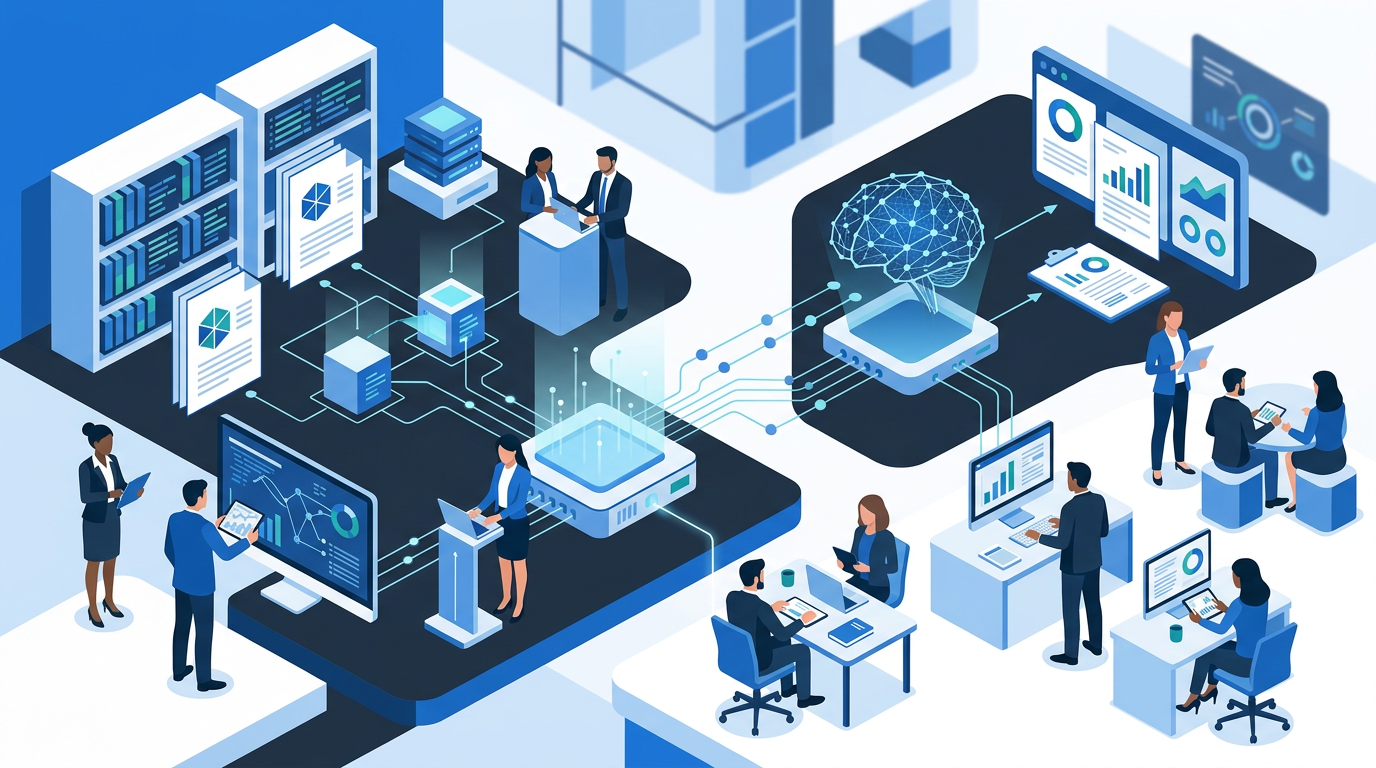
Microsoft describes RAG as a pattern that combines search with large language models so responses are grounded in your data, following a three-step flow: retrieve, augment, generate. (Microsoft Learn)
Here’s the thing… RAG isn’t a model. It’s a workflow that makes your assistant act less like a confident intern and more like a careful analyst who cites the folder.
Retrieve: your system finds the most relevant passages from your docs (policies, SOPs, contracts, product sheets).
Augment: those passages get added to the prompt as grounding context.
Generate: the AI writes the answer, ideally sticking to what it just retrieved.
That last step is why RAG is helpful but not magical. If the retrieval is weak, or the answer isn’t constrained, you can still get a confident mess. The difference is: with RAG, you can measure and improve it.
Why business owners should care about RAG retrieval augmented generation business
If you run a business, your best answers usually live in boring places: onboarding docs, spreadsheets, PDFs, email templates, and that one SOP nobody admits they haven’t read.
A plain chatbot doesn’t know your business. So it fills in gaps. RAG pushes the assistant to pull from your “source of truth” first.
Ask yourself: how many hours per month does your team spend answering the same questions, rewriting the same emails, or searching for “the latest version” of a doc? What would happen if your assistant answered with citations to the right file the first time?
This is also why many teams start with training before tooling. If your team doesn’t have clean docs, a AI business trainer can help you standardize knowledge first, then plug it into RAG.
What RAG changes (and what it doesn’t)
Let’s break it down. RAG improves the odds your assistant uses your real data, but it doesn’t guarantee perfection.
It changes: where the answer comes from (your docs first), how you can audit it (citations), and how fast you can update knowledge (reindex vs retrain).
It doesn’t change: the fact that the model can still misunderstand context, misread a table, or phrase a guess like it’s a fact.
If you’ve ever trusted an auto-corrected spreadsheet formula without checking it, you already understand the risk. The output looks professional right up until it ruins your afternoon.
A simple RAG example: customer support answers from your policies
Imagine a customer asks: “Can I return this after 45 days?”
Without RAG, a model might answer based on common retail patterns, not your policy. With RAG, it retrieves your return policy doc and answers using that as the source.
Now the practical question: do you want your support team to approve returns based on “probably,” or based on your actual rules?
This is where model choice matters too. Many businesses pair Claude (Anthropic, strong at business writing and careful reasoning) with a RAG layer so support replies sound human and stay anchored to policy. Gemini (Google, great in Workspace and with PDFs/images) is a solid fit when the “truth” is spread across Drive folders and formatted docs.
What the numbers say (three quick data points)
Microsoft reports that replacing single-shot RAG with a knowledge base improved evidence recall by up to 46%. (Azure AI Foundry Blog)
In the same post, Microsoft says combining a smaller agent model with agentic retrieval improved evidence recall by up to 54%. (Azure AI Foundry Blog)
Microsoft also reports 34% token cost savings from reducing retrieval tool calls in these setups. (Azure AI Foundry Blog)
Those aren’t vanity metrics. Evidence recall is basically: did the assistant actually bring back the right info to answer from? If it retrieves the wrong chunk, the model can write a beautiful wrong answer. That’s not “AI.” That’s just faster confusion.
How to tell if your business is ready for RAG
You don’t need a data science department. You need clarity.
You have repeat questions: support, HR, sales, ops, vendor onboarding.
You have stable source docs: SOPs, policies, service descriptions, pricing rules.
You can tolerate “I don’t know” sometimes (better than wrong answers).
If your docs are scattered, outdated, or full of conflicting versions, fix that first. That’s why our onboarding guide for AI training for business teams starts with cleaning up your internal knowledge.
Common RAG mistakes (so you don’t pay twice)
Treating RAG like a “set it and forget it” chatbot. It needs testing and monitoring.
Feeding messy docs. Garbage in, confident garbage out.
Skipping ownership. Someone has to own the knowledge base, like it’s an employee that can’t stop talking.
If you’re trying to decide whether to build this in-house or get help, our breakdown of what does an AI consultant do is a good sanity check before you spend money in the wrong direction.
FAQ
Does RAG mean my AI won’t hallucinate?
No. RAG usually reduces made-up answers by grounding responses in documents, but the model can still misinterpret what it retrieved. The goal is fewer wrong answers and faster auditing, not perfection.
What documents should I use for a custom AI knowledge base?
Start with high-trust, high-usage docs: policies, SOPs, FAQs, product/service descriptions, and the email templates your team copies daily. Keep versions clean, and assign an owner.
Key Takeaways
RAG makes AI answers depend on your documents, not vibes.
Better retrieval usually means better answers. It’s measurable, testable, improvable.
If your docs are messy, fix the knowledge first.
Claude and Gemini are strong picks for business-ready RAG assistants.
If you want your team to actually use RAG well (without turning the rollout into a months-long science project), start with structured training and a clean knowledge base.


Comments